
This page covers flying clubs in the Caribbean that post their own aircraft rental or training rates. For now it lists clubs in Guadeloupe and Martinique, the French islands of the Lesser Antilles. Other islands are held until at least two schools there publish prices on their own pages. Some clubs charge yearly dues on top of the hourly rate, so read the notes under each club. Rates are shown in euros first, the way the club lists them, with an estimated US dollar figure beside each one. Where the school prints a date we show it, and where it does not, the card says "Not listed by the school" beside the date we checked the page. We leave out prices the school marks as old or expired, pages that contradict themselves, and prices dated more than 24 months ago. Check with the club before you plan a trip.
How to read this page
Prices are in euros (€) first. The clubs write the euro sign (€) on their pages, and we read it as euros (EUR), the currency used in Guadeloupe and Martinique. Figures with a public source link to it and show the date we checked. Where a school does not say something, the page says "Not listed by the school". Where we could not find a reliable source, it says "Unverified. We couldn't confirm a reliable source for this yet."
4 schools and clubs across 2 territories (Guadeloupe, Martinique). Prices change often, and clubs may charge yearly dues and add fuel, landing or licence costs, so check with the club first.
Jump to: Aéroclub de l'Aviation Civile et de Guadeloupe (ACACG) · Aéroclub de Saint-François Caraïbes (ASFC) · ACF Aviation · Horizon Caraïbes
Aéroclub de l'Aviation Civile et de Guadeloupe (ACACG)
Location: Les Abymes, Guadeloupe
Airport: Pointe-à-Pitre Le Raizet airport · Airport code: TFFR Location source ↗ · checked Oct 29, 2026
Rates effective: The rate sheet is headed "Tarifs au 01/04/2026" (rates as of April 1, 2026)
Tax: Not listed by the school
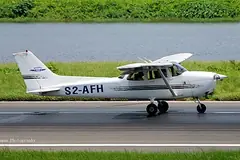 Cessna 172 Skyhawk
On its home page the club says the private pilot course needs at least 47 hours with an instructor, usually 50 to 55, and that the flight hour covers the aircraft's depreciation, maintenance and fuel. It also lists a French aero federation (FFA) licence at €101 for 2027 and other costs it calls approximate, including, in its words, "Des redevances pour délivrance des licences ou inscription aux examens pour environ 200 euros" (licence and exam fees of about €200).
Aéroclub de Saint-François Caraïbes (ASFC)
Location: Saint-François, Guadeloupe
Airport: Saint-François aerodrome (Amédée-Huyghues-Despointes) · Airport code: TFFC Location source ↗ · checked Oct 29, 2026
Rates effective: The club says the rates page lists its prices for 2026
Tax: Not listed by the school
- Cessna 172 Skyhawk
Wet (fuel included) or dry: Not listed by the school
Yearly membership is €60 for members under 21, per the club. The one-month membership is for pilots who are only passing through Guadeloupe, per the club.
ACF Aviation
Location: Le Lamentin, Martinique
Airport: Martinique Aimé Césaire airport (Z.A.G Aimé Césaire) · Airport code: Not listed by the school Location source ↗ · checked Oct 29, 2026
Rates effective: Not listed by the school
Tax: Not listed by the school
- Cessna 172 Skyhawk
Wet (fuel included) or dry: Not listed by the school
Both rental prices are "à partir de" (from) prices on the school's rental page. The school says renters fly after a checkout with its chief instructor.
Horizon Caraïbes
Location: Le Lamentin, Martinique
Airport: Martinique Aimé Césaire international airport · Airport code: Not listed by the school Location source ↗ · checked Oct 29, 2026
Rates effective: Not listed by the school
Tax: Not listed by the school
Hourly rate: Not listed by the school
The club's rental page does not say what its listed prices cover, so we do not show them. Check with the club for current rental rates.
Rental and training rates from each school's own public page, in euros with an estimated US dollar figure. Last checked Oct 29, 2026.
Direction générale de l'Aviation civile (DGAC) basics
These points are in our own words from the public pages of the EU Aviation Safety Agency (EASA) and the French civil aviation authority (DGAC), which are the official word. Requirements vary, so confirm the details with Direction générale de l'Aviation civile (DGAC) and with the school before you plan training or a rental.
- Who issues licences. EASA, the European Union Aviation Safety Agency, sets common pilot licensing rules (Part-FCL) but does not issue licences itself; in France the national authority does. EASA says you can get a licence in any EASA member state, whatever your nationality.Source: EASA: Licensing for General Aviation (page shows no date) ↗ · checked Oct 29, 2026
- LAPL and PPL (aeroplane). EASA's general aviation licensing page describes two private licences. The Light Aircraft Pilot Licence, LAPL(A), is valid in Europe only, for non-commercial VFR flying in single-engine piston aeroplanes up to 2,000 kg with up to four people on board; it needs at least an LAPL medical. The Private Pilot Licence, PPL(A), can also be used outside the EU, is non-commercial, and is VFR unless you add an instrument rating; it needs at least a class 2 medical. EASA lists about 100 hours of theory for both, and at least 30 hours of flight instruction for the LAPL(A) and 45 hours for the PPL(A). LAPL(A) holders get credit toward a PPL(A). Pilots with a non-EU ICAO licence can convert it under set conditions, including exams, a skill test and a European medical.Source: EASA: Licensing for General Aviation (page shows no date) ↗ · checked Oct 29, 2026
- Commercial pilot licence (CPL). EASA's rules say a CPL applicant must be at least 18, complete theory and flight instruction at an approved training organisation (ATO), and pass theory exams and a skill test. A CPL lets you fly as pilot in command of single-pilot aircraft in commercial operations, with some limits, and as co-pilot.Source: EASA: Easy Access Rules for Aircrew, Part-FCL (revision from August 2023) ↗ · checked Oct 29, 2026
- Medical certificates. EASA's medical rules (Part-MED) link medicals to licences: at least an LAPL medical for the LAPL, at least class 2 for the PPL, and class 1 for the CPL and airline licences. A student pilot may not fly solo without the medical needed for the licence. A class 1 medical is valid for 12 months (6 months from age 60, or from age 40 for single-pilot commercial passenger flying). A class 2 medical is valid for 60 months until age 40, 24 months until age 50, then 12 months. You can renew up to 45 days before expiry.Source: EASA: Easy Access Rules for Aircrew, Part-MED (revision from August 2023) ↗ · checked Oct 29, 2026
- Where to take a medical. EASA's medical FAQs say a first class 1 medical can only be done at an aeromedical centre (AeMC), while class 2 and LAPL medicals can be done at an AeMC or by an aeromedical examiner (AME). A medical issued in any EASA member state is recognised in all of them.Source: EASA: Medical FAQs (page shows no date) ↗ · checked Oct 29, 2026
- Where the licence office is. The French civil aviation authority's page of regional licence offices lists the Antilles-Guyane civil aviation safety directorate (DSAC-AG) office at Martinique Aimé Césaire airport in Le Lamentin, and a Guadeloupe office in the control tower building at Le Raizet in Les Abymes. Both see visitors by appointment only. The page asks pilots to use the online flight crew portal (Portail PN) for any procedure that is available there, and to email only for procedures that are not, such as validating or converting a foreign licence.Source: DGAC: Bureaux des licences en régions (DSAC/IR) (updated July 9, 2026) ↗ · checked Oct 29, 2026