
This page covers flying clubs and flight schools in Germany that post their own aircraft charter and training rates. Many German clubs are member-run associations that charge annual dues and an admission fee, and some charge less per hour once you pay a yearly fee, so read the notes under each school. Rates are shown in euros first, the way the school lists them, with an estimated US dollar figure beside each one. We list a school's rates when its own current public page or rate sheet shows them. Where the school prints a date we show it, and where it does not, the card says "Not listed by the school" beside the date we checked the page. We leave out prices the school marks as old or expired, pages that contradict themselves, and prices dated more than 24 months ago. Pilot licences in Germany follow European (EASA) rules. Check with the school before you plan a trip.
How to read this page
Prices are in euros (€) first. The schools write the euro sign (€) or the word Euro on their pages, and we read it as euros (EUR), the currency of Germany. Figures with a public source link to it and show the date we checked. Where a school does not say something, the page says "Not listed by the school". Where we could not find a reliable source, it says "Unverified. We couldn't confirm a reliable source for this yet."
3 schools and clubs across 2 states (Bavaria, North Rhine-Westphalia). Prices change often, and some clubs charge membership, landing or fuel costs on top, so check with the school first.
Jump to: Fliegerclub Nürnberg · Luftsportverein Rietberg (LSVR) · Flugausbildungszentrum Dortmund
Fliegerclub Nürnberg
Location: Herzogenaurach, Bavaria
Airport: Herzogenaurach airfield · Airport code: EDQH Location source ↗ · checked Oct 29, 2026
Rates effective: Prices as of May 2026
Tax: Prices include German VAT (MwSt), per the club
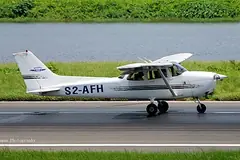 Cessna 172 Skyhawk
Prices are per hour and wet, per the club. A variable fuel surcharge based on the latest fuel purchase price is added on top; when we checked, the club listed it as €0 for Super petrol and €8.99 an hour for diesel. Training and checkout prices include the instructor, and each training session also carries a €15 briefing fee. Guest members can fly the club aircraft after a checkout for €20 a day, €100 a week or €150 a month, and pay €24 an hour on top of the hourly price.
Luftsportverein Rietberg (LSVR)
Location: Büren, North Rhine-Westphalia
Airport: Paderborn-Lippstadt Airport · Airport code: EDLP Location source ↗ · checked Oct 29, 2026
Rates effective: Charter prices effective April 1, 2026
Tax: Not listed by the school
- Cessna 172 Skyhawk
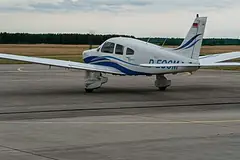 Piper PA-28 Archer II
Charter is billed per hour of engine running time (at cruise rpm) and includes fuel and oil, so it is wet, per the club. The club says a fuel surcharge has been built into these prices since spring 2022 and is reviewed every quarter. The hourly prices shown assume the optional yearly base charter fee of €300; without it, each hour costs €32.10 more, and the club says the fee pays off from about 10 hours a year. Membership is €330 a year for active members, and the admission fee for a pilot who already holds a PPL(A) or LAPL(A) is €300 (€200 when moving from another club). The six Piper Archer III aircraft share one price, as do the two Cessna 182RG aircraft.
Flugausbildungszentrum Dortmund
Location: Dortmund, North Rhine-Westphalia
Airport: Dortmund Airport · Airport code: Not listed by the school Location source ↗ · checked Oct 29, 2026
Rates effective: Prices as of January 2026
Tax: Prices include 19% German VAT (MwSt), per the school
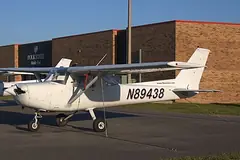 Cessna 152
- Piper PA-28 Archer II
- Cessna 172 Skyhawk
All prices include fuel, insurance and VAT, per the school. Billing is by flight time, except that the school adds 10 minutes to the flight time on departures from Dortmund because of the long taxi routes and possible waits at the holding point. A safety pilot is available on request. We have not listed the school's Cessna 421, which it offers only with its own pilot, or its Cessna 172 D-EFKD, because the school's web page and its price list give that aircraft different model names. The school's Redbird simulator is €60 an hour for its own students (plus an instructor if needed) and €99 an hour for others.
Rental and training rates from each school's own public page, in euros with an estimated US dollar figure. Last checked Oct 29, 2026.
Luftfahrt-Bundesamt (LBA) basics
These points are in our own words from Luftfahrt-Bundesamt (LBA)'s public pages, which are the official word. Requirements vary, so confirm the details with Luftfahrt-Bundesamt (LBA) and with the school before you plan training or a rental.
- Who issues licences. EASA, the European Union Aviation Safety Agency, sets common pilot licensing rules (Part-FCL) but does not issue licences itself; in Germany the national authority does. EASA says you can get a licence in any EASA member state, whatever your nationality.Source: EASA: Licensing for General Aviation (page shows no date) ↗ · checked Oct 29, 2026
- LAPL and PPL (aeroplane). EASA's general aviation licensing page describes two private licences. The Light Aircraft Pilot Licence, LAPL(A), is valid in Europe only, for non-commercial VFR flying in single-engine piston aeroplanes up to 2,000 kg with up to four people on board; it needs at least an LAPL medical. The Private Pilot Licence, PPL(A), can also be used outside the EU, is non-commercial, and is VFR unless you add an instrument rating; it needs at least a class 2 medical. EASA lists about 100 hours of theory for both, and at least 30 hours of flight instruction for the LAPL(A) and 45 hours for the PPL(A). LAPL(A) holders get credit toward a PPL(A). Pilots with a non-EU ICAO licence can convert it under set conditions, including exams, a skill test and a European medical.Source: EASA: Licensing for General Aviation (page shows no date) ↗ · checked Oct 29, 2026
- Commercial pilot licence (CPL). EASA's rules say a CPL applicant must be at least 18, complete theory and flight instruction at an approved training organisation (ATO), and pass theory exams and a skill test. A CPL lets you fly as pilot in command of single-pilot aircraft in commercial operations, with some limits, and as co-pilot.Source: EASA: Easy Access Rules for Aircrew, Part-FCL (revision from August 2023) ↗ · checked Oct 29, 2026
- Medical certificates. EASA's medical rules (Part-MED) link medicals to licences: at least an LAPL medical for the LAPL, at least class 2 for the PPL, and class 1 for the CPL and airline licences. A student pilot may not fly solo without the medical needed for the licence. A class 1 medical is valid for 12 months (6 months from age 60, or from age 40 for single-pilot commercial passenger flying). A class 2 medical is valid for 60 months until age 40, 24 months until age 50, then 12 months. You can renew up to 45 days before expiry.Source: EASA: Easy Access Rules for Aircrew, Part-MED (revision from August 2023) ↗ · checked Oct 29, 2026
- Where to take a medical. EASA's medical FAQs say a first class 1 medical can only be done at an aeromedical centre (AeMC), while class 2 and LAPL medicals can be done at an AeMC or by an aeromedical examiner (AME). A medical issued in any EASA member state is recognised in all of them.Source: EASA: Medical FAQs (page shows no date) ↗ · checked Oct 29, 2026
- Who handles your licence in Germany. The LBA says it runs the theory exams for professional and instrument licences and ratings, such as the CPL, ATPL and instrument rating. For the LAPL, the PPL(A) and PPL(H), and sailplane and balloon licences, the LBA says the aviation authority of the relevant German federal state is responsible instead.Source: LBA: Theoretical exams (page shows no date) ↗ · checked Oct 29, 2026
- State aviation authorities. The LBA publishes a list of the aviation authorities of the German federal states, with their contact details, so you can find the one for the state where you live or train.Source: LBA: State aviation authorities (page shows no date) ↗ · checked Oct 29, 2026